ThreatLocker is sponsoring an F1 team, but not for the reason you think
CEO Danny Jenkins tells CRN why he’s spending money on one of the world’s most lucrative sports.
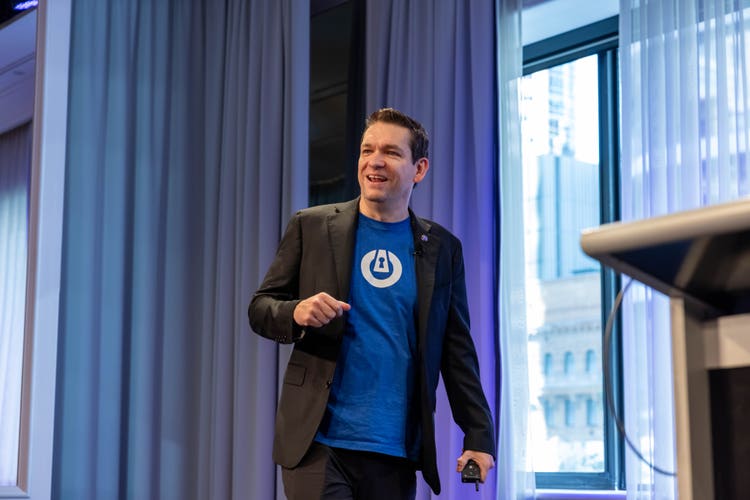
Danny Jenkins, CEO and co-founder at ThreatLocker has one simple mission: solve the world’s cybersecurity issues. And one of the ways he believes he can do that is through sponsoring an F1 team.
“We're thinking about how we can get more people to know who we are, what we're doing and why we're doing it,” Jenkins told CRN exclusively.
“The F1 thing gives us an opportunity to get about 1.2 billion people seeing us. It's either going to be an epic waste of money or it's going to be really good.”
Jenkins can’t say what team they’ve sponsored until the Austin arm of the F1 championship later this month.
During a brief stint down under the CEO of the cybersecurity platform told CRN Australia about the company’s growth plans and how they’re using the recent US$190 million cash injection.
In terms of ThreatLocker’s growth, Jenkins said “you're going to see us a lot more in Sydney in the next few months”.
“We have two major branding campaigns in Sydney and Brisbane. There is one sports team that I'm looking at backing in Australia,” he said.
When asked what sport code he is backing, all Jenkins could say was “footy”.
“Australia is a really important market for us,” he said.
“We have about $2 million of branding provision for the next quarter between Brisbane and Sydney, and that excludes the sports teams.”
New Investments
Earlier this year, the cybersecurity platform secured US$190 million in series F funding, which Jenkins said will fund several areas of the business.
“The goal is two things: how do we keep making the product easier, faster, and solving more problems? Expansion of the product is a huge part of it,” he explained.
“The second goal is to make as many people know about what we're doing, and why we're doing it.”
Jenkins continued, “The money [from the Series F] will be split between making sure everyone knows who we are, what we're doing, why we're doing it.
“Outside of F1, we're running a cool commercial. I won't go into too much detail. But when it launches, my goal is just accelerate as fast as we can.”
ThreatLocker has 30 staff in Australia, and Jenkins plans to add more engineers into the fold.
“Our biggest areas now is getting more local engineers on the ground. I'd say it'll probably end up doubling over the next year,” he said.
Essential Eight
Jenkins is a huge fan of Australia’s Essential Eight program for a few reasons. Firstly, he sees the similarities between the program and Threatlocker’s core values, which has helped the company financially.
"That's helped us get substantially higher demo count and trial count and order count per salesperson,” he said.
The second factor is the simple design and outline the Essential Eight gives organisations.
"When you give someone 150 things to do, they do none of them. When you give someone eight things to do, they're more likely to do them,” he said.
"They're choosing a lot of controls that align with us, but that's because that's our mission too, to stop cyber attacks. Giving people a simpler list-it's not perfect, but it should be your starting list. Then once you've got that eight, go and do the essential 16.”
Challenge for MSPs
Looking at the cyber market, Jenkins noted that the actual attack hasn't changed itself, how it's created has been changed.
“Essentially, we got smarter, faster agents instead of people doing it. The only new area of attack is you now got these agents on your computer, which are potentially much more dangerous,” he said.
Jenkins explained one of the challenges for MSPs today is that it isn’t their business they’re worried about, it’s someone else’s business.
“If I could give one piece of advice to an MSP, and we have about 6000 partners at this point, the ones that are most successful boasting growth in security, are the ones that are willing to go to their customers to tell them how it is,” he said.
“The problem is people who go into technology tend not to be people who want to debate and argue, and they don't run for politics, they run for technology.”
Jenkins said part of the job of an MSP is to tell their customers about the risks they have and how they can fix them in a straightforward manner.
"The MSP industry is getting far better at it, but I see a big delta between the best MSPs and the worst MSPs,” he said.
The most successful MSPs in Jenkin’s eyes are the ones that are straightforward and tell their client how it is, no matter how bad the news is.
"I see a lot of banter about ‘we're firing a client’, and it's not about firing a client. You just tell a client what the expectations are 99.9 percent of the time, a business owner will listen to you when you tell them [the truth],” he said.
“It's very much like when you go to the doctor doesn't say to you, "I need you to keep coming back and paying your fee’. The doctor says, ‘Get your ass on the treadmill, stop eating junk food’.”
Fear is at it’s peak
For Jenkins, he believes the fear of cyber attacks and AI attacks are at its peak right now.
"The fear of the world melting down is at the hottest it's going to be,” he said. “The problem's going to get worse, but the perception is going to get better.”
When Jenkins started ThreatLocker nearly a decade ago, he said headlines around cyber attacks happened once a year
"Now, it's the number one thing you look at on the news every day, whether it's a cyber attack, it's Open AI or Claude AI or someone's going to blow up or humans are going to be destroyed by AI. It's the number one thing,” he said.
“The first time the President of the United States even mentioned like the word ransomware was in 2021 when Joe Biden said the Colonial Pipeline was attacked. Now, it's every single day.”
This story is a part of our CRN Cybersecurity Week coverage. Read more security stories here.