How Adobe Acrobat Studio Helps Resellers Bring Trusted AI Productivity to SMB Customers
Generative AI has moved beyond experimentation, with SMBs and mid-market organisations seeking practical ways to improve productivity, accelerate content creation and unlock value from their documents.
But adoption brings tougher questions: How can businesses deploy AI securely, trust its outputs and achieve productivity gains without adding cost or complexity?
Adobe believes Acrobat Studio can help bridge that gap.
Combining AI Assistant, PDF Spaces and Adobe Express, it is designed to help users find and summarise information, create content and turn document insights into action.
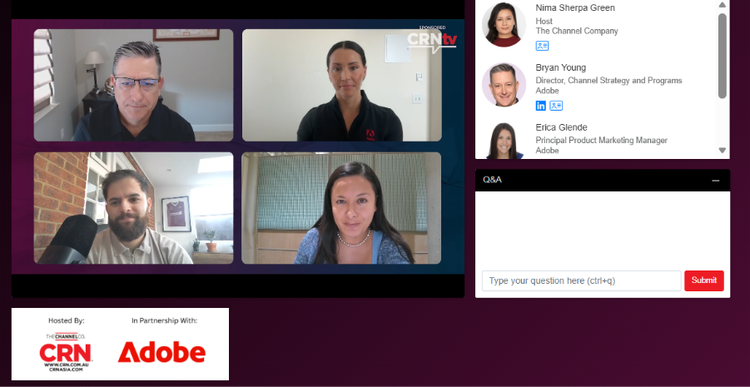
In this CRN webinar, powered by Adobe, Bryan Young, director of channel strategy and programs at Adobe, and Erica Glende, principal product marketing manager at Adobe, joined CRN editorial director Nima Sherpa-Green and content strategist Matt Harris to explore what customers expect from AI-powered document intelligence and how partners can turn demand into a repeatable business opportunity.
AI strategies move into deployment
Research conducted for the webinar among around 80 technology leaders, partners and decision-makers showed how quickly the market is maturing.
89 per cent said their customers had at least some form of formal AI strategy, with most running pilots or actively deploying the technology.
One in five said customers already had an AI-powered document workflow solution, while two-thirds were planning future investment, much of it within the next year.
Employee productivity and cost reduction were the leading drivers, with sales, operations and marketing expected to be the main beneficiaries.
Overall, 95 per cent agreed that document-centric AI capabilities would be valuable to customers’ AI strategies over the next 12 to 24 months.
Contracts, invoices, reports and research contain critical business information that can remain difficult to search, connect and reuse.
This makes document intelligence relevant across legal, finance, accounting, IT and procurement as well as sales, marketing and operations.
For partners, the timing creates an opening to engage customers before their workflows and preferred suppliers become fixed.
As Glende explains: “Whoever earns our customers’ trust during this evaluation window tends to keep the account long term.
“There are a lot of AI solutions out there, but in terms of AI that supports document workflows, this is where we can really have an impact and focus on where our customers already are in their documents.”
Trust remains the adoption test
Demand is rising, but barriers remain.
Data security, privacy and accuracy accounted for almost two-thirds of respondents’ leading concerns about AI-generated outputs.
Customers also cited manual processes, difficulty locating information and excessive content to review.
Respondents said stronger security controls, more accurate responses and better governance and compliance features would improve trust, suggesting partners must address technology, process and oversight together.
“Customer data is never used for AI training, and Adobe does not use customer documents or data to train any of these LLM models that we’re working with,” says Glende.
“All of our data is also encrypted in transit and at rest. We also have very grounded, traceable citations, so any AI-generated summaries or insights include direct sources to the documents and even the exact sentence from which the information came.”
Productivity without more tool sprawl
Economic uncertainty, reduced spending and budget constraints were among the biggest threats to growth identified by respondents.
Against that backdrop, Acrobat Studio’s consolidation proposition could be as important as its individual AI capabilities.
Combining PDF tools, e-signatures, AI and content creation in one platform can reduce application switching, licensing and management overheads while simplifying training.
An Adobe-commissioned Forrester Total Economic Impact study found organisations using Acrobat Studio reported a 35 per cent improvement in document review and insight generation, a 30 per cent acceleration in content production and estimated annual savings of $100 per user.
This gives resellers a concrete conversation around measurable outcomes.
They can begin with repetitive tasks such as reviewing documents, summarising reports, extracting contract insights or creating presentations, then demonstrate the time and cost saved.
Building a repeatable partner opportunity
The commercial opportunity is substantial. 91 per cent of respondents said customers were likely or very likely to increase investment in AI-powered productivity and document intelligence solutions over the next 12 months.
However, partners were also clear about what they need before they can capture that demand.
Clear customer use cases topped the list, followed by technical training, sales enablement materials, marketing development funds and other practical programme support.
The strongest route to growth is to build a repeatable AI practice around the full customer journey rather than treating the opportunity as a one-off licence sale.
“Partners can help SMB customers identify the right use cases, deploy the technology, drive adoption and demonstrate measurable value,” Young says.
“The partners that capitalise most successfully on this will be the ones that build a repeatable AI practice around the customer journey, from discovery and deployment all the way through adoption, expansion and ultimately retention.”
The research also exposed a long-running concern: three-quarters agreed that vendors tend to prioritise larger partners at the expense of SMB-focused firms, despite smaller partners’ collective reach, local expertise and trusted customer relationships.
Adobe is developing a more data-driven coverage model based on capabilities, customer relationships and growth potential rather than size alone.
Distributors, VIP Marketplace, digital experiences and automation are intended to widen access to insights, enablement and opportunities.
It is also working to simplify programme participation, improve digital enablement and make incentives easier to understand, while recognising partner value across adoption, retention and expansion rather than only the final transaction.
For resellers, the message is that AI productivity is becoming a practical channel play rather than a speculative one.
Customers are planning investment, but they want secure tools, credible use cases and evidence of business value.
Partners that can combine trusted technology with deployment guidance and ongoing adoption support will be best placed to turn that demand into longer-term customer relationships.
Watch the webinar here.
Want to learn more about AI-powered document intelligence, as well as see a more in depth look at our research? Download our new whitepaper, How Adobe Acrobat Studio Helps Resellers Bring Trusted AI Productivity to SMB Customers, here.
This article is sponsored by Adobe.